
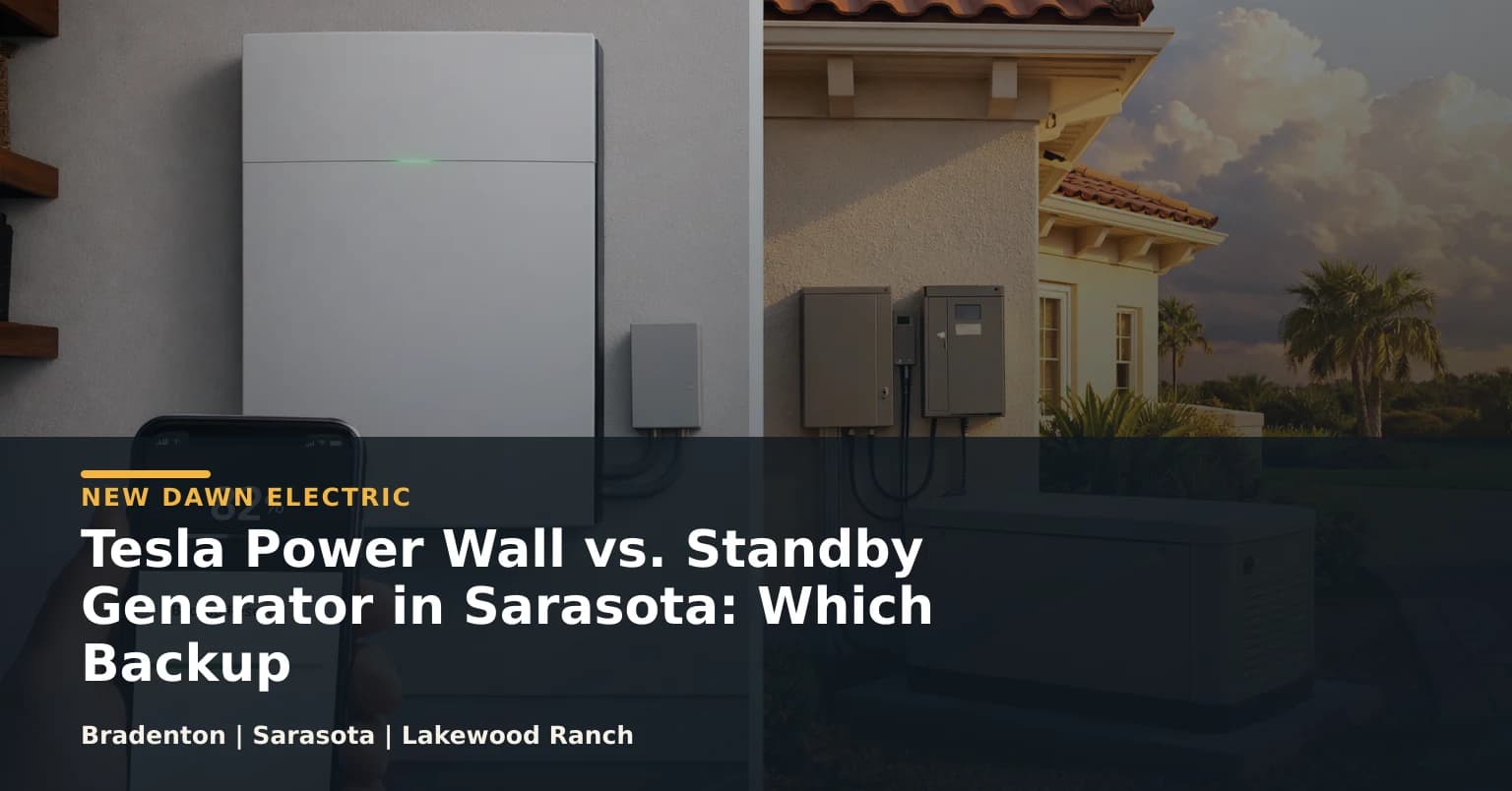
Tesla Power Wall vs. Standby Generator in Sarasota: Which Backup Approach Fits Your Home?
Tesla Power Wall vs. Standby Generator in Sarasota: Which Backup Approach Fits Your Home?
If you live in Sarasota, Bradenton, Lakewood Ranch, or anywhere on the Suncoast, you know summer storms and unexpected outages can upend everyday life fast. As local, code-conscious electricians, New Dawn Electric helps homeowners plan reliable backup power that fits how you actually live—whether that means a quiet battery system or a traditional standby generator. In this balanced guide, we’ll compare a Tesla Power Wall Sarasota setup with a standby generator so you can choose with confidence.
We’ll walk through critical-load goals, placement and neighborhood noise, fuel and runtime, maintenance differences, permitting, and how New Dawn’s Master Electrician oversight ties it all together for a safe, storm-ready installation.
How Backup Power Works on the Suncoast
Tesla Powerwall at a glance
A Tesla Powerwall is a rechargeable home battery that stores energy for use during an outage. It can be paired with solar or used alone for backup. Powerwalls switch on automatically, keep selected circuits running, and are managed through the Tesla app with features like Backup Reserve to help conserve energy when the grid is down. For Sarasota-area homes, a Powerwall is often chosen for its quiet operation, compact footprint, and seamless controls. Explore New Dawn’s planning approach here: Tesla Powerwall.
Standby generator at a glance
A standby generator is a permanently installed unit outside your home that runs on natural gas or propane to power selected circuits (or the whole home, when designed for that). It starts automatically when the power fails and can supply electricity as long as it has fuel. For longer outages or homes with heavier loads—like larger HVAC systems, well pumps, or medical equipment—generators remain a proven solution in Sarasota and Manatee counties. Learn more: Generator Installation.
Key Factors to Decide Between a Tesla Power Wall and a Generator
1) Critical loads and runtime goals
Start by defining the circuits you must keep on. This “critical loads” list often includes your refrigerator, a few lighting circuits, outlets for chargers and medical devices, your internet equipment, and potentially a mini-split or smaller air handler depending on your system and goals. In Florida, cooling is a major consideration. Many standard central HVAC systems draw significant power on startup and during operation; running them during longer outages can be challenging for a single battery system.
- Tesla Power Wall Sarasota perspective: Best for essential-circuit backup, quiet operation, and smart energy management. Great if your priority is keeping the lights on, staying connected, protecting food, and riding out short to moderate outages with minimal noise. With solar, a Powerwall may recharge during daylight if conditions allow; exact performance varies and should be reviewed on site.
- Generator perspective: Strong choice when you need higher surge capacity or longer runtime—especially if you plan to run more demanding loads or want broader home coverage. As long as fuel is available, a properly sized standby generator can operate for extended outages.
New Dawn Electric can help right-size either solution and configure a dedicated “critical loads” subpanel so your backup power goes exactly where you want it.
2) Space, placement, and neighborhood noise
Placement and sound matter in Sarasota neighborhoods, HOAs, and coastal lots with setbacks and salt-air exposure.
- Tesla Powerwall: Typically wall-mounted near your electrical panel, indoors or in a protected location that meets code and manufacturer clearances. It’s quiet—no engine noise—making it attractive for villas, townhomes, and properties with strict HOA rules. It also uses less outdoor yard space than a generator pad.
- Standby generator: Requires a stable pad outside with clearances from windows, doors, and property lines; HOA and municipal guidelines apply. Generators produce engine noise, especially during weekly exercise tests. We’ll review placement options, decibel ratings, and neighborhood considerations before design and permitting.
3) Fuel and charging reality
- Generator fuel: Most standby units in our area run on natural gas (if available at your property) or propane. If you’re on propane, you’ll need an appropriately sized tank with safe placement and regular refills. Natural gas can be convenient, subject to utility availability and pressure considerations.
- Powerwall charging: Powerwalls charge from the grid and, when paired with solar, can harvest daytime energy. During an outage, recharging depends on weather, system configuration, and consumption. We’ll help you set realistic expectations for your home and goals.
4) Maintenance and long-term care
- Generator maintenance: Engines need periodic service—oil changes, filters, battery checks, and load testing. Scheduling annual or semi-annual upkeep keeps systems ready for storm season. You’ll also want periodic run tests and to monitor fuel levels (for propane setups).
- Powerwall maintenance: No engine, no fuel, and minimal routine maintenance. Firmware updates and occasional system checks through the app help ensure readiness. We recommend pairing any backup system with whole-home surge protection to help defend sensitive electronics during Florida’s lightning-heavy seasons.
5) Upfront cost, permits, and utility coordination
Every property is different. Electrical panel capacity, meter position, flood elevation, roof solar plans, and HOA rules can all influence the best approach and final investment. Our generator page outlines typical ranges—portable hookups from around $500 installed and standby generators from about $8,000 installed—but your exact pricing is site-specific. New Dawn Electric will review your panel, load goals, placement options, local permitting, and FPL-related constraints before making a final recommendation. If a panel upgrade or transfer equipment is needed, we’ll include it in a clear, code-compliant proposal.
Real Sarasota Scenarios: Which Backup Approach Fits?
Townhome or villa with strict HOA rules
If your HOA limits exterior equipment, yard pads, or audible systems, a Tesla Power Wall Sarasota setup often fits more smoothly. Wall-mounted indoors or in a garage, it’s quiet and visually discreet. We’ll confirm allowable locations, discuss ventilation and clearances, and coordinate any HOA documentation needed for permitting.
Single-family home aiming for longer outages coverage
For families who want extended runtime and broader coverage—potentially including select HVAC operation—a standby generator may be the better backbone. We’ll map your critical loads, weigh full-home versus partial-home coverage, and review fuel options. Transfer switches, interlocks, and load-management strategies keep the system safe and code-compliant.
Solar homeowner seeking quiet, day-to-day value
If you either have solar or plan to add it later, a Powerwall can support self-consumption goals and provide quiet nighttime backup. The Tesla app’s Backup Reserve control offers flexibility for storm season. We’ll evaluate your panel and load priorities to set realistic expectations for outages and everyday use. For details, visit our Tesla Powerwall page.
Rural edge or well pump needs
Properties on the edge of service areas or with well pumps, larger freezers, or shop equipment may point toward a generator to handle surges and sustained loads more comfortably. Natural gas availability or a correctly sized propane tank becomes important here. We’ll confirm starting currents, wire sizes, and grounding so the system performs reliably and safely.
What Both Systems Need for a Safe, Smooth Installation
- Load calculation and critical-circuits plan: We’ll identify what you want to power and how long you expect to run it, then size equipment accordingly.
- Panel and meter review: Adequate capacity, proper grounding and bonding, and clean breaker space are essential. If a panel upgrade is prudent, we’ll include it.
- Transfer and protection equipment: Correct transfer switches or interlocks prevent dangerous backfeed. Whole-home surge protection is strongly recommended on the Suncoast.
- Permits and inspections: We handle code and permitting in Manatee and Sarasota counties, and coordinate with FPL as needed for safe operation.
- Homeowner training: We walk you through operation, the Tesla app (when applicable), Backup Reserve settings, testing routines, and seasonal readiness checks.
Pros and Cons: A Practical, Local View
Why a Tesla Power Wall Sarasota install may be right for you
- Quiet, clean, compact installation with minimal exterior footprint
- Smooth app-based controls and visibility into your energy use
- Pairs well with solar for self-consumption goals and smart storm prep
- Low routine maintenance and no fuel deliveries
Considerations: Battery capacity is finite, so heavy loads and longer outages require careful planning, potential load-shedding, and realistic expectations—especially if you hope to run large HVAC equipment. We’ll model your critical loads and discuss options before you decide.
Why a standby generator may be right for you
- Stronger surge handling and sustained power for longer outages
- Potential to support more circuits or partial/whole-home coverage
- Fuel can be continuous (natural gas) or replenished (propane)
Considerations: Exterior placement, sound, and fuel infrastructure are part of the design. Generators need ongoing professional maintenance and occasional testing. We’ll map HOA and setback constraints early in the process to avoid surprises.
New Dawn Electric: Sarasota’s Code-Conscious Backup Power Partner
New Dawn Electric serves Bradenton, Sarasota, Lakewood Ranch, Manatee County, and Sarasota County with Master Electrician oversight and clear, clean scheduling and communication. Our team is known for careful diagnosis, practical guidance, and storm-ready planning—whether you’re leaning toward a Tesla Powerwall or a standby generator. We design with your property, your priorities, and local code in mind, then install neatly and verify operation before we leave.
- Tesla Powerwall planning and installation: /smart-home-specialty-installations/tesla-powerwall/
- Standby and portable generator solutions: /smart-home-specialty-installations/generator-installation/
- Whole-home surge protection for storm season: /smart-home-specialty-installations/whole-house-surge-protection-services/
- Electrical safety audits and panel health: /service-repair/electrical-safety-audit/
Next Steps: Plan Your Backup Power the Right Way
Still deciding between a Tesla Power Wall Sarasota setup and a standby generator? That’s normal—most homeowners benefit from a quick site visit and load review before choosing. We’ll look at your panel and meter location, flood zone and placement options, HOA or architectural guidelines, natural gas or propane feasibility, and your comfort and runtime goals. We’ll also discuss integration with future upgrades like EV charging and smart home controls, so your investment supports the